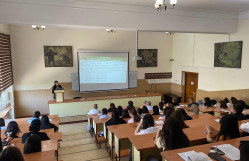
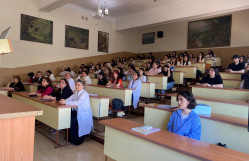
At the Faculty of Biology of Baku State University, a scientific seminar was held featuring a presentation by Dr. Humira Huseynova, Doctor of Biological Sciences and a lecturer at the Department of Botany and Plant Physiology. The seminar was titled "Natural Vegetation of the Caspian Coast: Its Classification, Mapping, and Phytosociological Characteristics." It was attended by the faculty’s professors, academic staff, and students.
During the seminar, Dr.Huseynova shared comprehensive scientific insights into the rich biodiversity of the Caspian coastal vegetation, its ecological and geobotanical characteristics, the classification of phytocoenoses, and their mapping using GIS technologies.
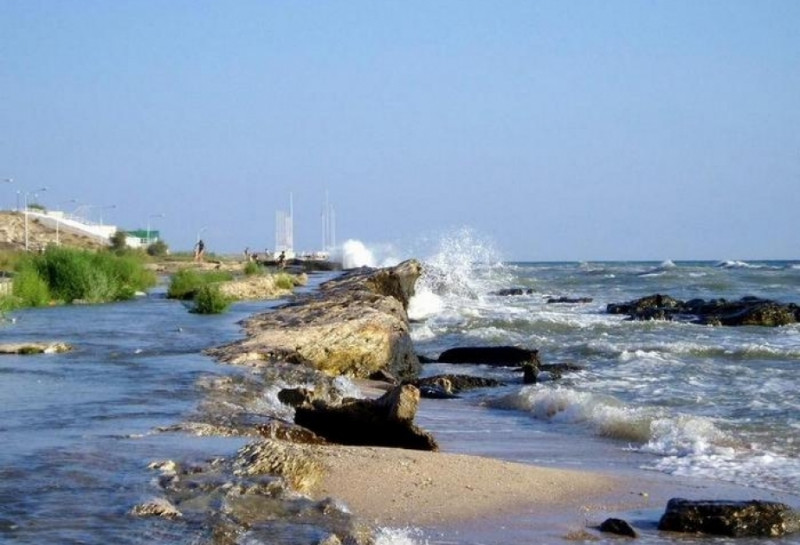
Her presentation highlighted that the vegetation of the Caspian coast is shaped by climatic conditions, relief, soil, and anthropogenic factors. The region is divided into six main ecological-geobotanical zones: forest, shrubland, semi-desert, desert, coastal sandy desert (psammophyte), and wetland vegetation. Each zone features unique biomorphological structures, dominant species, and specific ecological requirements.
Research has identified 25 formation classes, 125 formation groups, and 179 associations along the Caspian coast. This classification system encompasses the phytosociological structure of ecosystems and the organizational levels of biodiversity. The findings provide a deeper understanding of the morphology, functional structure, and ecological role of the vegetation cover.
The seminar also addressed the process of ecological-geobotanical mapping. The maps, produced at a scale of 1:200,000 using modern Geographic Information Systems (GIS) and computer modeling, accurately depict the geographic distribution, zonal, and intrazonal characteristics of the phytocoenoses. These maps serve as a crucial scientific basis for biodiversity conservation, natural resource management, and ecological monitoring.
Another segment of the seminar covered phytosociological analyses, the phenological stages of plants, how vegetation periods vary across different zones, and the implications of these variations for ecological stress adaptation, biomass, productivity, and ecosystem resilience.
The scientific results presented at the seminar are of strategic importance for the conservation of natural resources in the Caspian coastal region of Azerbaijan, ensuring ecological balance, managing natural grazing lands, and developing practical ecological strategies.