

A scientific seminar dedicated to “Science Day” was held at the Faculty of Biology
-lg.jpg)
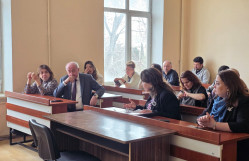
Another scientific seminar dedicated to “Science Day” was held at the Faculty of Biology. The event aimed to further strengthen the scientific environment within the faculty, inform young researchers about current scientific directions, and present the priority topics of modern biological science to a wider audience. The seminar was attended by the faculty administration, academic staff, master’s students, and undergraduates.
The presentation was delivered by PhD student of the Department of Botany and Plant Physiology and researcher at the Scientific Research Laboratory of Bioengineering, Boyukhanim Jafarzade. The seminar was devoted to the topic: “Investigation of the antioxidant defense system in plants differing in salt tolerance.”
Within the framework of the seminar, the effects of salinity stress on the physiological and biochemical processes of plants were analyzed in a comprehensive and systematic manner. The presentation included results of studies conducted on barley, wheat, and bean plants grown under saline conditions. Parameters such as germination rates, morphological characteristics (including root and shoot length), biomass, as well as physiological and biochemical properties were examined in detail.
During the presentation, detailed information was provided on water balance in plants, water deficit, relative water content, the state of photosynthetic pigments, the activity of antioxidant enzymes, and the dynamics of non-enzymatic components. It was noted that increasing salinity stress leads to disruption of osmotic balance, enhanced ion toxicity, and increased oxidative stress in plants. As a result, plant growth, development, and productivity are negatively affected.
A comparative analysis of different plant species based on their salt tolerance levels was also presented. It was highlighted that plants with higher salt tolerance exhibit a more active antioxidant defense system, and the elevated activity of antioxidant enzymes plays a crucial role in mitigating the harmful effects of reactive oxygen species. In this regard, the study of antioxidant defense mechanisms was emphasized as an important scientific direction for assessing plant adaptation potential to stress factors.
The presentation underlined that the obtained results have not only theoretical but also practical significance. In particular, these studies provide an important scientific basis for the selection of agricultural crops suitable for saline soils, identification of stress-resistant varieties, preservation of productivity, and development of effective agrotechnical measures. It was also noted that such research contributes to the efficient use of soil resources, strengthening food security, and the formation of sustainable agricultural models adapted to environmental conditions.
The seminar was met with great interest by the participants, followed by discussions and a Q&A session. At the end of the event, it was emphasized that such scientific seminars play a significant role in promoting biological research, sharing scientific knowledge, and increasing young people’s interest in science.
-xs.jpg)